Shapes
A graphical representation of an object’s form or its external boundary, outline, or external surface; it is distinct from other object properties, such as color, texture, or material type. In geometry, shape excludes information about the object’s location, scale, orientation and reflection.
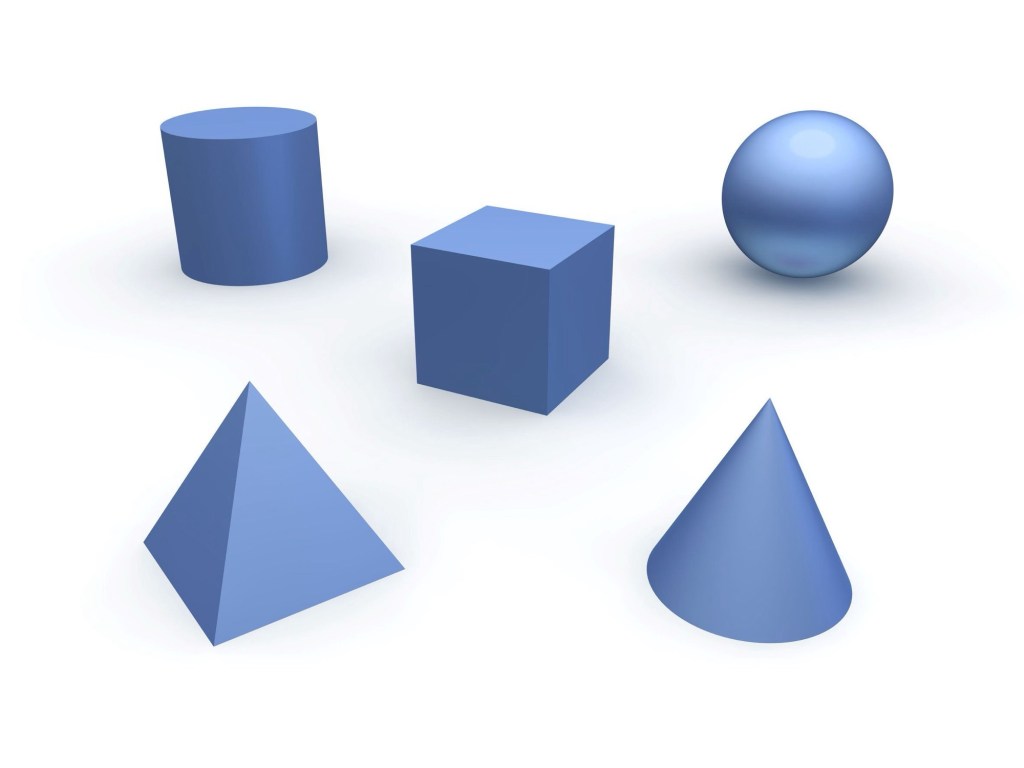
The three basic shapes are a square, a triangle and a circle. All other shapes are derived from these. Organic shapes, for the most part, are circular in nature. So an oak leaf for example, is just a circle that’s been pinched and pulled in different directions.
The researchers calculate that there are around 500 million shapes that can be defined algebraically in four dimensions and they anticipate that they will find a few thousand building blocks from which all these shapes are made.
Quadrilateral
Add
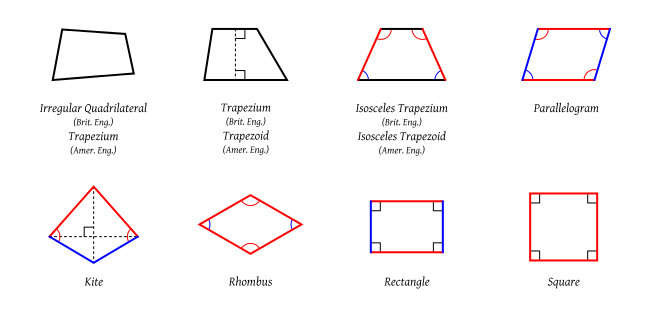
Different shapes have different names depending upon their number of sides. For example, A 3-sided shape is called a triangle. A 4-sided shape is called a quadrilateral which is further classified into squares, rectangles, etc.
A quadrilateral is defined as a two-dimensional shape with four sides, four vertices, and four angles. There are two main types: concave and convex. There are also various subcategories of convex quadrilaterals, such as trapezoids, parallelograms, rectangles, rhombi, and squares.
Properties of Quadrilaterals
-They have four vertices.
-They have four sides.
-The sum of all interior angles is 360°.
-They have two diagonals.
-A quadrilateral can be regular or irregular. A regular quadrilateral must have 4 equal sides, and 4 equal angles, and its diagonals must bisect each other.
 Shapes